LLM Serving
Deploy dedicated LLM endpoints that fits your performance requirements and budget in just three steps.
1. Choose your LLM
Select or enter the Hugging Face model name of your choosing and provide your Hugging Face token. Also provide a name for the dedicated endpoint you are going to deploy.
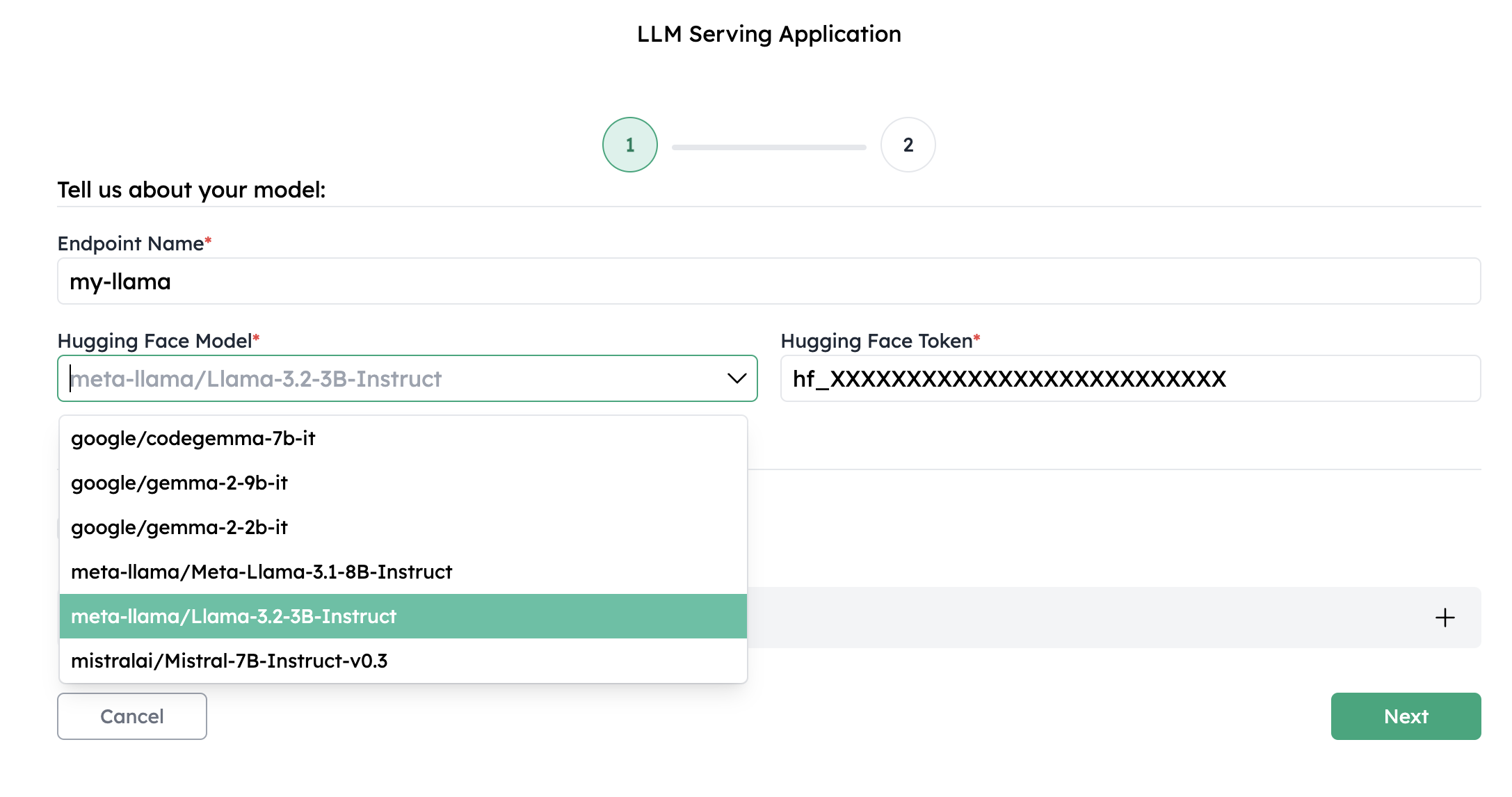
Make sure you have been granted access to the model you selected. If not, please go to https://huggingface.co/ and request for access.
2. Plan and optimize
Choose the cluster or the region you want to deploy the model. Based on that, NVIDIA CCluster presents three pre-configured deployment configurations to suit different requirements:
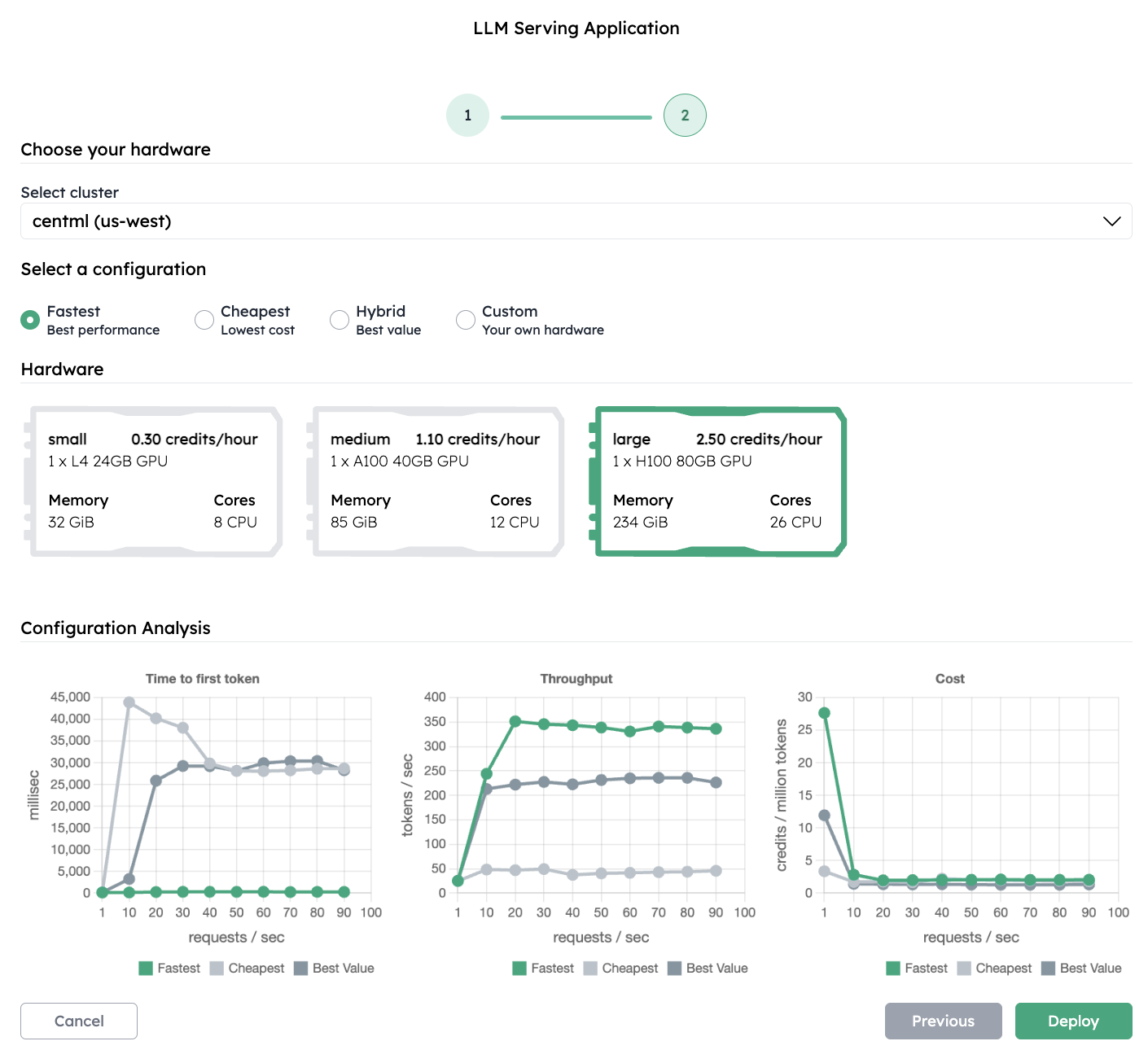
- Best performance: A configuration optimized for latency and throughput, suitable for high-demand applications where performance is critical.
- Lowest cost: A cost-effective configuration designed to minimize expenses, ideal for non-critical applications with lighter usage.
- Best value: A balanced configuration offering a mix of performance and cost efficiency, tailored to provide an ideal trade-off for general usage.
Each configuration is accompanied by detailed analysis on:
- Time to first token: Indicates the latency between sending a request to a language model and receiving the first piece of its response.
- Throughput: Measures the number of requests the model can handle per second.
- Cost per token: Shows the cost of generating a million tokens.
These insights help you choose the configuration that best meets your needs.
Optional details
Expand Optional Details for runtime, observability, and scaling controls. These are independent of the preset (or Custom) performance configuration.
- Enable logging — collect container output and show it on the deployment Logs tab.
- Enable Model Caching — store model files in a node-local persistent cache so restarts and replicas on the same node can skip re-downloading weights.
- Enable session affinity — best-effort sticky routing via the
X-Session-Idrequest header. Requests with the same header value land on the same pod; requests without it are routed at random. Affinity is not durable across scaling, rollouts, or restarts. - Environment variables — extra variables passed to the serving container.
- Annotations — optional key/value metadata.
| Setting | Description |
|---|---|
| Min Replicas | Lower bound for replica count. |
| Max Replicas | Upper bound for replica count. Set equal to Min Replicas for a fixed size. |
| Max Concurrency | Target in-flight requests per replica. Required when max is greater than min. |
| Cooldown Period (s) | Scale-down stabilization time, from 0 to 3600. |
Scaling min or max replicas on a running deployment does not create a new revision. Changing the serving spec does. See Managing Deployments.
(Optional) Performance customization
For advanced users, NVIDIA CCluster also offers an option to customize their model performance configuration. Simply click the "Custom" configuration to gain full control over several tunable parameters.
3. Deploy and integrate
Finally, click "Deploy". Once the deployment is ready in a few minutes, copy the endpoint url and go to https://<endpoint_url>/docs to find the list of API endpoints to start using your LLM deployment. We offer API compatibility with CServe, OpenAI, and Cortex, making integration with other applications seamless.
From the deployment detail page you can stream logs, open the in-browser Terminal, pause or resume, clone, edit (new revision), or roll back. See Managing Deployments.
Endpoints are never public, so every request must authenticate with a Bearer token or a client certificate. The example below uses a Bearer token; see Securing Endpoints for all options.
curl -X 'POST' 'https://<endpoint_url>/openai/v1/chat/completions' \
  -H 'Authorization: Bearer <your_bearer_token>' \
  -H 'accept: application/json' \
  -H 'Content-Type: application/json' \
  -d '{
  "messages": [
    {
      "role": "user",
      "content": "what is the meaning of life?"
    }
  ],
  "model": "meta-llama/Llama-3.2-3B-Instruct",
  "max_tokens": 512,
  "n": 1,
  "presence_penalty": 0,
  "stream": true,
  "stream_options": {
    "include_usage": true
  },
  "temperature": 0.7,
  "top_p": 1
}'
For more details on how to use the LLM deployment, please refer to the examples we've prepared.